Trust Is the Real Deliverable
Testing produces evidence. Trust is what the organisation actually consumes.
Every so often, I find myself coming back to a question that seems surprisingly simple.
What exactly does a testing leader deliver?
For much of my career, I don't think I would have hesitated in answering it. We deliver test coverage, defect analysis, automation, readiness assessments and a view of quality before software reaches production. They're the artefacts testing teams work hard to produce and the things programmes naturally ask us to report on. If somebody had asked me twenty years ago what success looked like, I would almost certainly have described it in those terms.
Looking back, I don't think I was wrong. I just don't think I had gone far enough.
Those artefacts matter because they're the visible output of the work. They represent the discipline and rigour that good testing brings to a programme, and without them it's difficult to imagine an organisation making informed delivery decisions. What changed for me was realising they were never the end of the story.
As the programmes I worked on became larger and the decisions became more visible, I began noticing something I hadn't really appreciated earlier in my career. Two testing teams could produce work of a similarly high technical standard and yet leave their stakeholders in very different places.
One governance forum might finish with a clear understanding of the position and what needed to happen next. Another could spend an hour looking at equally comprehensive evidence and still leave with uncertainty. For a while, I assumed the difference must be somewhere in the testing. Often it wasn't.
The difference was whether the people in the room understood what that testing meant for the decision they were about to make.
Like most testing professionals, I'd spent years refining the technical side of the role. Better planning, better coverage, better reporting and better automation. Those things absolutely improved the quality of our testing, and they remain essential today.
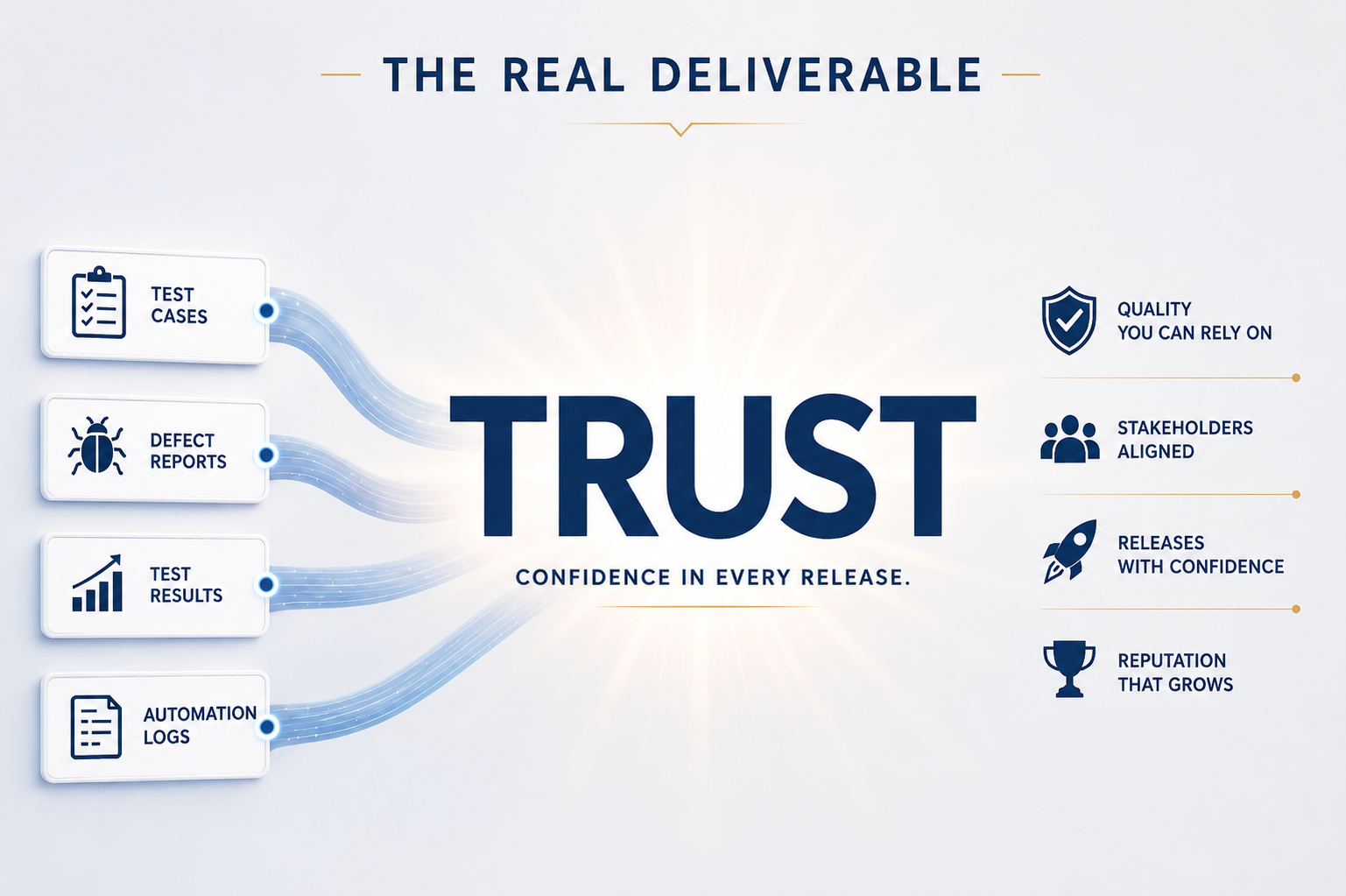
Over time, though, I began to see them slightly differently. They weren't the final deliverable in themselves. They were contributing towards something larger.
Trust.
Or perhaps more accurately, justified confidence.
I don't mean the kind of confidence that comes from optimism, momentum or a programme desperately wanting to believe it's ready. I mean confidence earned because the evidence has been interpreted honestly, uncertainty has been acknowledged openly and the people making the decision understand both what the testing tells them and what it doesn't.
Looking back, I think I only really understood that when I started leading programmes where the quality of the testing was no longer the hardest part of the job. The testing itself was often strong. Helping other people understand what it meant was much harder.
I've sat in Steering Committees where the testing artefacts were comprehensive, the reporting detailed and the coverage difficult to fault, yet the discussion never seemed to settle. The questions kept coming, not because people necessarily doubted the testing, but because they were still trying to work out whether they could trust the decision sitting in front of them.
I've also experienced the opposite. The reports weren't necessarily longer and the testing wasn't obviously more extensive, yet somebody presented a balanced position that acknowledged what was understood, what remained uncertain and what that meant for the programme. The conversation became calmer. The decision became clearer. The room could move forward because the testing had been translated into something people could genuinely rely upon.
That distinction stayed with me.
Coverage and confidence serve different purposes. Coverage tells us what we examined, where the testing reached and what evidence was gathered. It's essential, but on its own it doesn't answer the question every stakeholder is ultimately trying to resolve:
Can we make this decision with confidence?
That's a different question.
Somebody still has to take everything the testing has revealed, combine it with an understanding of the programme, the risks that remain and the context surrounding the release, and help the organisation understand what those findings actually mean.
Looking back, I think that's the point where the role quietly changed for me.
Earlier in my career, I probably thought the job finished when the testing was complete and the reporting had been produced. Over time, I came to realise that was really the point where everything we'd learned had to become useful. The evidence still needed to be interpreted and translated into something another person could rely upon when making a decision.
Perhaps that's why I've gradually stopped thinking about reporting as the final step in testing. Reporting is how we communicate the evidence. The more important responsibility is helping people understand what that evidence should cause them to do.
Once I began looking at the role through that lens, I found myself thinking much more carefully about how governance forums interpreted the information we presented. I paid closer attention to language because I'd seen how the same underlying facts could leave one room appropriately reassured and another deeply uncertain. Often the difference wasn't the testing itself, but how successfully we'd connected the evidence to the decision people were trying to make.
I also became much more comfortable acknowledging uncertainty.
Earlier in my career, I probably worried that saying "we don't know" would weaken confidence. There is a natural temptation in testing leadership to believe our job is to remove uncertainty from the room, and that admitting its existence somehow suggests the testing hasn't done enough.
Experience taught me something different.
There are always things we don't know. Sometimes the evidence is incomplete. Sometimes the testing hasn't reached them. Sometimes the system is changing too quickly for certainty to be realistic. Pretending otherwise may make a meeting easier, but it rarely makes the decision better.
Confidence built on overstated information rarely survives contact with reality. Confidence built on an honest explanation of what is understood, what remains uncertain and how those uncertainties are being managed tends to endure because people know exactly what they're relying upon.
That changed the way I thought about trust.
Trust isn't created because testing finds very few defects, nor does it appear because a dashboard looks reassuring. It grows when stakeholders repeatedly discover that the picture being presented is balanced, proportionate and honest. Difficult messages arrive as readily as positive ones. Recommendations change when the evidence changes, rather than because the pressure around the programme has increased.
Over the years, the organisations I most admired weren't necessarily those with the largest automation estates or the most sophisticated reporting. They were the ones where testing had become a trusted part of decision-making. Executives weren't looking to the testing function simply to understand what had happened. They wanted help understanding what they should do next.
That also explains something I've observed repeatedly throughout my career. Two testing leaders can run functions of remarkably similar technical quality and yet be regarded very differently by the organisation.
Both may understand the technical craft, build capable teams and produce work of a consistently high standard. Yet when a difficult programme decision emerges, one person's judgement is actively sought out.
I don't think that difference is usually explained by technical capability. By that stage of a career, technical credibility is expected. The difference is more often the trust that has accumulated around someone's judgement.
People have learned that this person doesn't overstate confidence when uncertainty remains or create unnecessary concern when the evidence doesn't support it. Difficult conversations happen early rather than late. Their position doesn't change simply because the programme has become uncomfortable with it, but it will change when new evidence genuinely changes the picture.
That reputation isn't built in a single meeting or on the back of one successful programme. It accumulates quietly.
Every Steering Committee, executive review and difficult delivery conversation leaves people with a slightly better understanding of what it's like to rely on your judgement. They notice whether the risks you raise turn out to matter, whether the confidence you express holds up later and whether you're equally prepared to deliver good news and bad.
Eventually, those experiences become your reputation, and your reputation becomes part of the assurance the organisation believes it is receiving when you speak.
Looking back, I don't think I appreciated that for a long time. I thought I was becoming better at communicating testing. In reality, I was learning how to help organisations develop justified confidence in the decisions they were making.
That realisation shaped much of my thinking about testing leadership, and it's one of the reasons I eventually built the Stakeholder Management Masterclass for Test Leaders. Not because trust can be reduced to a framework—it can't—but because I came to believe the capabilities that contribute to it, including judgement, stakeholder management, communication under pressure and influence, can be developed far more deliberately than most of us were ever taught.
For much of our profession's history, we've invested enormous effort in teaching the technical craft. The leadership craft has often been left to experience. Some of that is inevitable. There are things you only really understand after sitting in enough difficult rooms, but I don't think that means we should leave the whole journey to chance.
The longer I've worked in testing, the less I think our profession has ever really been in the business of finding defects.
Finding defects is one of the ways we create value, certainly, but it has never been the purpose of the profession. The purpose is to help organisations understand risk well enough to make decisions they can stand behind.
Coverage, automation, reporting, governance and every other discipline we've developed matter because they strengthen the evidence available to the people making those decisions.
But evidence alone has never been enough.
Someone still has to interpret it. Someone has to explain where confidence is justified and where it isn't. Someone has to acknowledge what remains unknown. And when the answer is uncomfortable, someone has to be trusted enough for the organisation to listen.
Perhaps that's why I now think differently about what a testing leader actually delivers.
The reports matter. The coverage matters. The automation matters. They always will. They're the foundation upon which credible assurance is built.
But they're not the thing the organisation ultimately consumes.
They're the evidence from which something more valuable is formed.
Trust.
Looking back, I think that's one of the quieter shifts a testing leader makes over the course of a career. You spend years learning how to produce better testing, and then gradually realise that the organisation has been asking something more of you all along.
It needs evidence, certainly.
But when the decision becomes difficult, what it really needs is someone whose judgement it trusts enough to act on that evidence.
Testing produces evidence.
Trust is what the organisation actually consumes.