The Skills That Decide How Far a QA Career Really Goes
The skills that build your career aren't the same skills that finish it.
Looking back over my career, I think one of the most confusing moments for many testing professionals arrives long after they've become technically competent. In fact, there's a strong argument that it arrives because they've become technically competent.
For the first part of your career, everything feels logical. You learn the craft, your technical judgement improves and people begin trusting you with more responsibility. As you become better at finding issues, understanding risk and solving increasingly difficult delivery problems, opportunities tend to follow. For quite a few years, the relationship is reassuringly straightforward. The better you become technically, the further your career progresses.
Then something changes.
It isn't dramatic, and there usually isn't a conversation that tells you the rules have shifted. Most people simply reach a point where they feel as though they're working just as hard, producing work they're genuinely proud of and continuing to grow technically, yet their career no longer seems to move with the same momentum it once did.
I've watched that happen to many capable testing professionals over the years. If I'm honest, I experienced a version of it myself. Some of the strongest testers I worked alongside reached a point where progression slowed in ways that were difficult to explain. Their technical judgement was still highly respected. They were still solving complex problems and making valuable contributions to major programmes. Nothing about the quality of their work suggested they had reached their ceiling.
For a long time, I think many of us assume the answer is to become even better technically. It's a perfectly rational response because that's exactly how our careers have worked up until that point. We deepen our expertise, learn another tool, take on more complex programmes or add another capability, believing that another step forward technically will naturally lead to the next step professionally.
Sometimes it does, but I've come to believe there is a point where that relationship begins to weaken. The skills that carry you through the first half of a testing career aren't necessarily the same ones that determine how far you go in the second. That isn't because technical excellence suddenly stops mattering - it never does - but because, at senior levels, technical capability has quietly become the entry requirement rather than the thing that distinguishes you.
I've never worked with a respected Test Director who lacked technical credibility. That foundation remains essential throughout your career. The difference is that, by the time you reach senior leadership, almost everyone around the table has earned credibility of their own. Being technically strong is no longer the thing that makes people look to you. It's simply what earns you a seat in the room.
I don't think I fully appreciated that transition when it was happening to me. For much of my career, technical depth had been one of the clearest ways to establish credibility, so it was natural to assume that becoming more senior simply meant applying that depth to larger and more complicated problems. What I gradually discovered was that the problems weren't just becoming larger. People were beginning to expect something different from me.
The question had changed.
Earlier in your career, people are largely trying to establish whether you're right. Can you analyse the problem? Can you identify the risk? Can your testing be trusted? Those are important questions, and answering them well is how much of our professional credibility is built.
As your responsibilities grow, another question gradually begins to sit above them: Can I trust your judgement?
The distinction is subtle until you find yourself on the other side of it. Earlier in your career, your contribution is largely measured by the quality of the analysis you produce. You find issues others miss, ask better questions and build confidence through the rigour of your testing. Your work often speaks for itself because, for the most part, that's exactly what the organisation needs from you.
As you become more senior, the work gradually becomes less about producing the analysis and more about helping other people act on it. Instead of discussing the defect itself, you're discussing what it means for the programme. Instead of explaining the testing, you're helping a Steering Committee decide whether the organisation should accept a particular level of risk. Increasingly, your value comes from reducing uncertainty for other people rather than simply reducing defects in the product.
Looking back, I don't think anyone ever explained that to me. There wasn't a point in my career where somebody sat me down and said that technical capability would still matter enormously, but it would no longer be the only thing determining my effectiveness.
Like many people, I learned it through experience: governance meetings where the technical answer wasn't enough, executive conversations where the room needed a position rather than more information, and difficult releases where there was no perfect answer and somebody still had to exercise judgement. Over time, those experiences started to change my understanding of what senior testing leadership actually involved.
A pattern began to emerge. The testing leaders who progressed furthest weren't necessarily the ones who knew the most about testing. They were often the people others instinctively turned to when the programme became uncertain.
That didn't mean they always had the answers. Quite often they didn't, and I think that was part of what made their judgement valuable. They were comfortable acknowledging what they knew, what they didn't yet know and where genuine uncertainty remained. They could take a complex testing picture and help other people understand what mattered without creating unnecessary anxiety or false confidence.
Perhaps most importantly, they had earned the trust of the people around them.
The older I've become, the less I think stakeholder trust has much to do with one outstanding presentation or a single successful programme. It accumulates quietly over dozens of conversations where people discover that your judgement is balanced, your advice is measured and your recommendations are driven by what you genuinely believe is right for the programme rather than what is easiest for you.
Influence develops in much the same way.
Most senior testing leaders spend much of their careers working with people they have no formal authority over. Delivery leads, architects, business sponsors, risk teams, vendors and executives all have legitimate priorities of their own. Very little moves simply because the Head of Testing wants it to move, and I think understanding that is another important transition in a testing leader's career.
The leaders who navigate those environments well aren't usually the loudest people in the room, nor are they necessarily the most political. More often, they're the people who understand how confidence is formed. They know when a challenge needs to be made, when a stakeholder needs to be heard, when an issue genuinely needs escalation and when giving people space to reach their own conclusion will achieve more than pushing harder ever could.
Looking back, I think that's a far more sophisticated leadership capability than I appreciated earlier in my career. For a long time, technical excellence had been enough to carry me forward. Eventually, I realised the work itself had changed. I wasn't simply being asked to provide assurance anymore. I was increasingly being asked to help other people decide what that assurance meant.
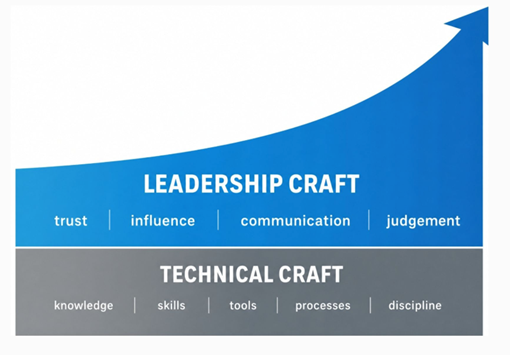
I think that's also why so many capable testing professionals become frustrated with their own progression. They continue investing in the skill that has served them well for years, often becoming genuinely exceptional practitioners, without realising that the role they now aspire to demands a second craft sitting quietly above the first.
That second craft is rarely developed deliberately.
Most of us learn it through exposure and, if we're fortunate, through working alongside leaders worth observing. We learn through governance meetings that don't quite go as planned, executive reviews where our message doesn't land the way we expected, and programmes where the technical answer turns out to be only one part of a much more complicated leadership problem. Gradually, we begin to understand that aligning people, building confidence and helping an organisation make sound decisions under pressure are skills in their own right.
Some people find themselves in environments where they get that exposure early. Others develop it slowly over many years. Many highly capable testing professionals never really get the opportunity at all, and I think that's one of the reasons career progression at this level can sometimes feel more mysterious than it needs to be.
I've always felt that was an avoidable gap.
We invest enormous effort teaching the technical craft of testing. We create frameworks, certifications, methodologies and communities that help people become better practitioners. Yet the leadership craft that sits above it—building stakeholder trust, influencing without authority, communicating with executives and forming judgement under uncertainty—is still often left to experience and chance.
That observation became one of the reasons I built the Stakeholder Management Masterclass for Test Leaders. Not because I believe leadership can be reduced to a framework, but because I don't believe these capabilities should only be learned through difficult experience. The technical side of our profession has always been taught deliberately. I think the leadership side deserves the same attention.
If your career feels as though it has slowed despite producing work you're genuinely proud of, it may be worth considering whether the gap is really technical at all. Perhaps the organisation has simply started evaluating something different from the thing that carried you this far.
Looking back now, I don't think the most important transition in a testing career is moving from Test Analyst to Test Manager, or from Manager to Director. Those changes matter, of course, but the more significant transition is often much less visible.
It's the point where the organisation gradually stops evaluating only the quality of your testing and begins evaluating the quality of your judgement.
Technical excellence gets you into the room. Judgement determines how often you're invited back.
I've come to think that's the transition many of us were never taught to recognise. The testing still matters, and it always will. But somewhere along the way, the career stops being shaped solely by how much confidence you can create in the software and starts being shaped just as much by how much confidence other people place in you.
For many of us, recognising that is when the second half of the career really begins.