
The Boardroom Learns to Ask About Quality
For years, quality was something organisations delegated. Increasingly, it is something they have to answer for.
Over the last few years, I've noticed conversations about quality happening somewhere they rarely used to.
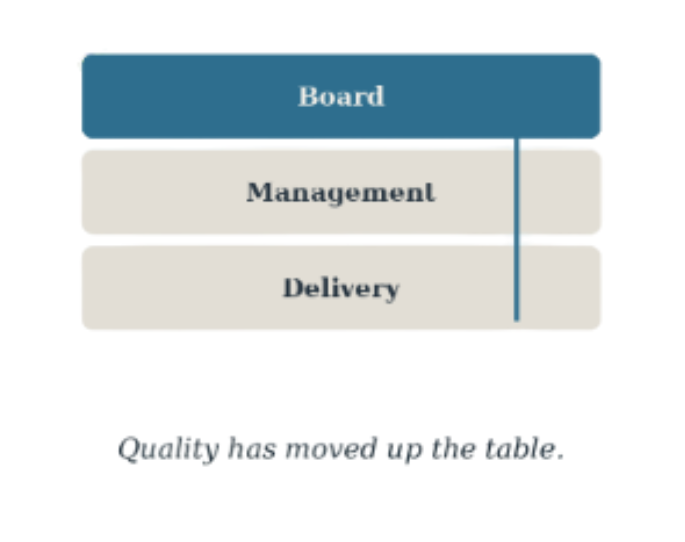
At the top of the organisation.
For much of my career, quality lived relatively close to delivery. It was discussed in test forums, programme meetings and governance reviews. A summarised version travelled upwards, usually as part of a broader status report, and by the time it reached an executive committee or board it had often been reduced to a colour, a sentence and perhaps a recommendation.
That wasn't necessarily a weakness in the way organisations operated. It reflected how responsibility was divided. Testing teams understood the detail, programme leadership interpreted it and senior executives relied on that machinery to tell them whether there was anything they needed to know.
For a long time, that arrangement worked reasonably well.
I'm not sure it works in quite the same way anymore.
Increasingly, I've found that the questions about quality are travelling further up the organisation. Executives want to understand the assurance underneath a recommendation, not simply receive the recommendation itself. In the regulated environments where I've spent much of my career, I've also seen greater interest in whether an organisation can demonstrate how it understood the risks behind the decisions it made.
The conversation feels different.
For years, quality was something organisations could largely delegate. Increasingly, it is something senior leaders have to answer for.
I don't think one thing caused that change. Looking back, several shifts seem to have arrived at roughly the same time and gradually reinforced one another.
The visibility of failure is certainly part of it.
Years ago, a significant technology problem could remain largely an internal matter. It would be investigated, corrected and discussed through the appropriate governance channels. Depending on its impact, customers or regulators might become involved, but many failures remained relatively contained within the organisation.
That is much harder now.
When an important system fails, customers can feel it almost immediately. The issue can become public quickly, and once that happens the questions rarely remain technical for very long. People want to know how the organisation allowed it to happen. What did leadership know? When did they know it? What assurance existed? Why was the remaining risk considered acceptable?
Those aren't testing questions.
They're accountability questions.
And once the questions reach that level, the board cannot answer them simply by saying that the testing function was responsible for quality.
I've watched a similar change through regulation.
In financial services particularly, there has been a noticeable shift towards greater scrutiny of how organisations understand and manage operational and technology risk. The existence of a control is no longer particularly reassuring if nobody can explain whether it was effective, what evidence supported that conclusion and who relied upon it when making the decision.
That has consequences for assurance.
When senior leaders know they may eventually have to explain the basis on which an important decision was made, they naturally become more interested in the evidence underneath it. The question changes from “Has this been tested?” to something closer to “What gives us confidence that this is safe enough to proceed?”
Those questions sound similar until you're the person expected to answer them.
One can be answered largely through activity. The other requires judgement.
The pace of modern delivery has complicated things further.
For much of my career, assurance was built around identifiable moments. A programme moved towards a release, testing accumulated evidence and eventually the organisation reached a point where it could decide whether to proceed. There was usually a recognisable moment when confidence was assessed.
Continuous delivery has made that boundary much less obvious.
Systems change constantly. Dependencies shift underneath them. Cloud platforms and third-party services introduce risks that may sit well outside the traditional testing boundary. AI is beginning to add another layer because some systems can behave in ways that aren't entirely captured by the deterministic testing models many organisations grew up with.
The question for leadership is therefore becoming less about whether a system was safe at the moment it was released and more about whether the organisation can continue to justify confidence as that system changes.
I think that's an important distinction.
A board that once needed reassurance around major delivery events is increasingly overseeing an environment that never really stops moving. The assurance model has to move with it.
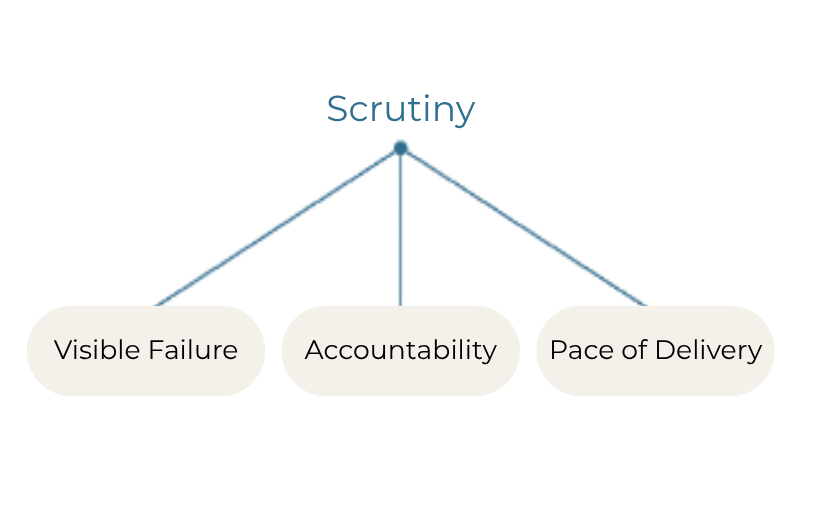
When I put those changes together — greater visibility when things fail, increased accountability and a delivery environment that changes continuously — I can understand why quality is finding its way into more senior conversations.
The board isn't suddenly interested in testing.
It's interested in whether the organisation can stand behind the decisions testing helps inform.
That distinction matters because I don't think the answer is simply to take our existing reporting and push it further upwards.
I've sat through enough senior governance forums to know that more detail rarely creates more confidence. A board doesn't need another operational dashboard. It doesn't need twenty pages of execution metrics or a detailed explanation of everything the testing team has done.
Those things may be essential elsewhere, but by the time assurance reaches senior executives, a different kind of translation is required.
Where does the real exposure sit? What do we understand with reasonable confidence? What remains uncertain? Which assumptions are we relying upon? If we proceed, what exactly are we accepting, and why do we believe that acceptance is reasonable?
Those are much harder questions to answer than whether testing is green.
They also expose something about the testing leadership role that I don't think I fully appreciated earlier in my career.
For many years, I measured much of my effectiveness by what happened within the testing function. Was the strategy sound? Was the coverage appropriate? Were the teams performing well? Did the governance identify problems early enough? Was the reporting accurate?
All of those things still matter enormously.
But as my own work moved closer to executive and regulatory scrutiny, I began to realise there was another responsibility sitting above them. The assurance had to remain credible after it left the testing function.
It had to survive the next room.
That changed how I thought about reporting and, eventually, how I thought about my own role.
A technically accurate position can still be poor assurance if the people accountable for the decision cannot understand what it means. Equally, a beautifully simplified executive message can be dangerous if important uncertainty has been removed simply to make the answer easier to consume.
The challenge is somewhere between those two extremes.
You have to preserve the integrity of the evidence while translating it into the language of the decision.
I've found that particularly important when the answer isn't comfortable.
Senior forums don't need testing leaders to remove uncertainty that genuinely exists. They need us to explain it well enough that they can decide what to do with it. Sometimes the strongest assurance position I've been able to provide hasn't been “we're confident”. It has been a clear explanation of where confidence ends.
That takes a different kind of discipline.
It means resisting the pressure to make a complicated picture sound simpler than it really is, while also resisting the temptation to protect yourself behind technical detail. Neither helps the person who ultimately has to make the decision.
Over time, I've come to believe this is where trust in a senior testing leader is really built.
Not because they always provide reassuring answers, but because the organisation learns that their position will remain balanced when the pressure increases. They won't overstate confidence to support a date, but they won't amplify uncertainty simply to protect themselves either. The evidence may change and their recommendation may change with it, but the reasoning remains visible.
When that judgement has been tested enough times, something interesting happens.
People start asking for it earlier.
The testing leader is no longer brought into the conversation simply to explain whether testing has finished. They're asked what they think the evidence means. Eventually, they may be asked for a view before the decision has even fully formed.
I've seen that transition in my own career, and I don't think it happens because somebody decides testing deserves greater organisational status. It happens because useful judgement becomes difficult to ignore.
That is why I see the movement of quality towards the boardroom as an opportunity for the profession, even though it brings greater scrutiny with it.
For years, people in testing argued that quality deserved a stronger voice at senior levels. In some respects, that argument is now being won for us, although not quite in the way we might have imagined.
Quality is arriving there because organisations have become more dependent on technology, because failures are more visible, because accountability is harder to delegate and because the systems themselves are becoming more difficult to understand.
The question is no longer simply whether quality belongs in that conversation.
It's whether testing and assurance leaders are prepared to hold their part of it.
That preparation isn't mainly about learning to present to a board. Presentation matters, certainly, but I think the deeper capability is judgement: understanding the evidence well enough to simplify it without distorting it, being comfortable acknowledging uncertainty, recognising what matters to the people carrying accountability and communicating a position that can withstand scrutiny after you've left the room.
Those capabilities have always mattered in senior testing leadership. I suspect they're becoming less optional.
It's also one of the reasons I eventually built the Stakeholder Management Masterclass for Test Leaders around judgement, communication and stakeholder confidence rather than testing technique. Not because the technical craft has become less important — without it there is no credible foundation for assurance — but because technical capability alone doesn't necessarily prepare somebody for the conversations that increasingly sit above it.
I don't expect those conversations to become easier.
If anything, systems are becoming more automated, interconnected and difficult for any single person to fully understand. Organisations will continue making decisions with incomplete information, and the people accountable for those decisions will continue looking for assurance they can genuinely rely upon.
When I look back over my career, I think that's the part of the shift I find most interesting.
Testing spent decades trying to demonstrate that quality mattered.
We may now be entering a period where that argument no longer needs to be made.
The harder question is what happens when the organisation agrees with us and starts asking senior testing leaders to help explain what quality actually means for the decisions being made at the top.
The work has already begun moving up the table.
And when the board eventually turns and asks whether the organisation can stand behind the decision, I don't think it will be looking for another testing report.
It will be looking for judgement it can trust.