
A testing leader can carry responsibility for the quality of an outcome while having very little authority over the people whose decisions determine it. I spent years learning how to work with that reality.
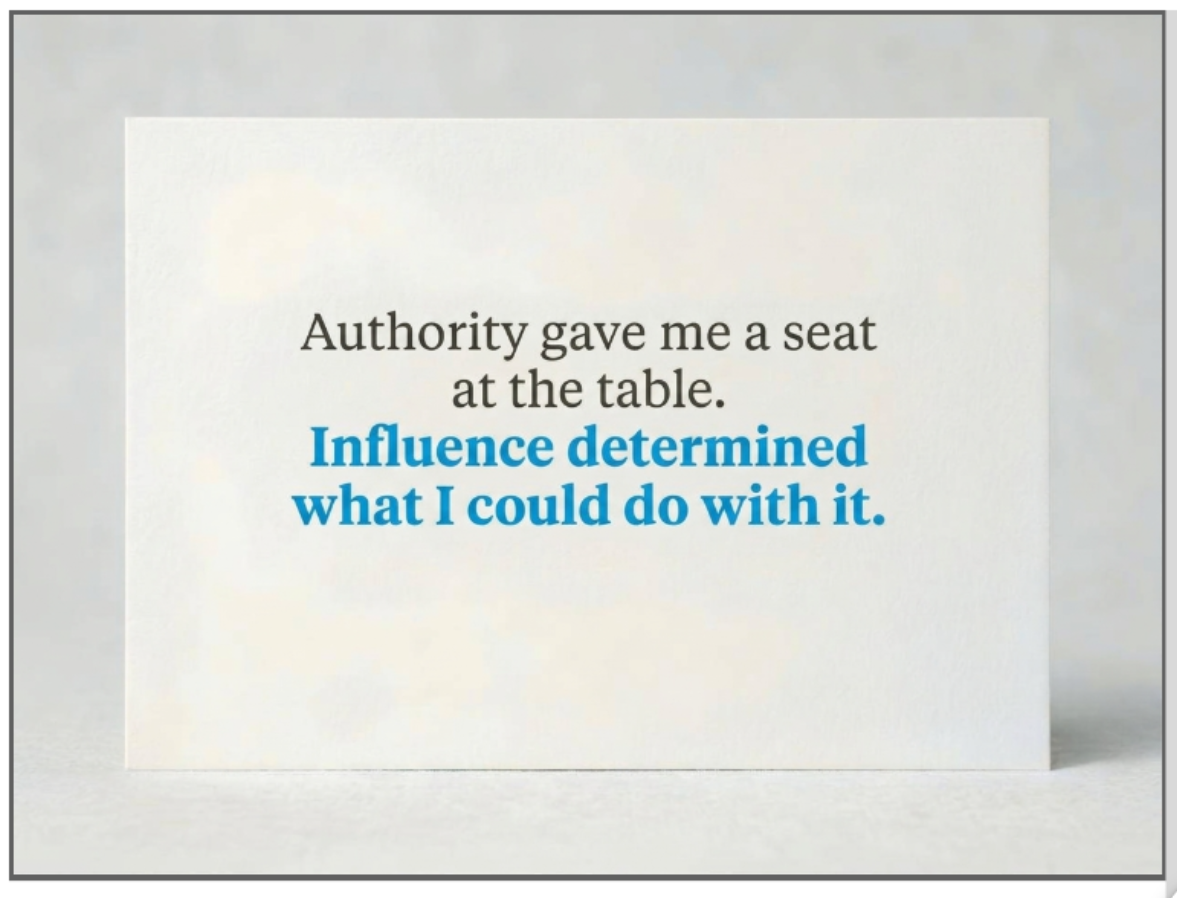
I spent quite a few years believing that seniority would eventually make some parts of testing leadership easier. As my career progressed, I expected to have more authority over the decisions affecting quality, particularly those where the testing evidence was reasonably clear. I knew there would always be disagreements, but I assumed that once I reached a certain level, I wouldn't have to work quite so hard to get people to act on a recommendation.
I did gain more authority as I moved into senior roles. I could shape the testing strategy, build teams, establish governance and have conversations with people I would previously have struggled to get in front of. But I also found myself responsible for increasingly complex outcomes, many of which depended on people who didn't report to me and had legitimate reasons for seeing the programme differently.
On large enterprise programmes, the testing function has relatively little direct control over many of the things that ultimately determine quality. Engineering makes design and implementation decisions. Vendors operate within their own delivery arrangements. Business stakeholders establish priorities and decide which trade-offs they are prepared to accept. Programme leadership has commitments to manage that extend well beyond testing.
As Test Director, I could challenge those decisions, present evidence, recommend a different approach, and escalate concerns when necessary. What I couldn't do was simply tell everybody involved to change direction because I believed the testing risk justified it.
I found that frustrating at times, especially when I felt we had done the work to establish a clear position. We might have spent weeks understanding a problem, assessing its implications and preparing a recommendation, only to find that the people who needed to act weren't ready to do so. I would leave those conversations wondering what more evidence they needed.
Looking back, I can see occasions where I was concentrating so heavily on the quality concern that I hadn't fully understood the decision being made around it. The stakeholders weren't necessarily questioning the testing evidence. They were weighing it against delivery commitments, operational consequences, commercial arrangements, and other risks that were equally real to them.
I remember this becoming particularly apparent as I moved into larger transformation programmes. A recommendation to extend testing could affect several delivery teams, change the sequence of a release or create problems with commitments already made elsewhere. From an assurance perspective, the recommendation might still have been entirely reasonable. But unless I understood what it meant for the people expected to act on it, I was often asking them to accept consequences I hadn't properly considered.
I became more interested in those consequences before taking a recommendation into a senior forum. I wanted to understand what the programme was trying to protect, where the genuine constraints were, and which parts of the testing position were essential. Sometimes that made my original recommendation stronger. Occasionally, it made me reconsider it.
I don't remember a particular moment when my thinking changed. It happened gradually, through enough conversations where I could see that having a sound technical position wasn't always sufficient to move a decision.
I also started paying closer attention to people who seemed able to influence a programme without having much formal authority over it.
I worked with testing leaders who were exceptionally capable technically but struggled to get their concerns heard outside the testing function. Their analysis was thorough, their understanding of the systems was strong, and they could explain the defects in considerable detail. Yet their recommendations sometimes carried less weight than those of another leader who appeared to say much less.
At first, I put some of that down to confidence or communication style. Over time, I began to see how much depended on the history those people had with the stakeholders around them.
When somebody raises a risk in a senior meeting, the room has usually formed an opinion about that person's judgement long before the conversation begins. People remember whether previous concerns were proportionate, whether commitments were met and whether the person helped the programme work through difficult decisions. They remember how someone behaved when the evidence was uncertain or when the answer wasn't what the programme wanted to hear.
I became conscious of the history I was building through my own recommendations. Every risk I raised contributed to how the next one would be received. If I consistently overstated concerns, I made it harder for people to recognise when something genuinely serious emerged. If I softened difficult messages to preserve relationships, I was creating a different problem for myself.
There were times when I had to say that I wasn't certain about the likely outcome, even though I had a reasonably strong view about what the programme should do. Earlier in my career, I might have worried that admitting uncertainty would make the recommendation sound weaker. I gradually found that senior stakeholders were generally comfortable with uncertainty when I could explain its boundaries and what it meant for the decision.
They didn't expect me to know everything. They did expect me to have thought carefully about what I was telling them.
Something similar happened with reliability. I hadn't given it much thought as a source of influence when I was younger. I regarded following through on commitments, providing accurate updates and raising concerns promptly as ordinary parts of doing the job properly.
They are ordinary, but on a difficult programme they become particularly noticeable.
When delivery is under pressure, people spend a surprising amount of time trying to establish which information they can rely on. They want to know whether an action will be completed, whether a reported position is accurate, and whether somebody will tell them early enough when things start moving in the wrong direction.
I saw how quickly confidence could weaken when those expectations weren't met consistently. An update arrived late without explanation. A concern was described differently depending on who was in the room. A commitment was made before anybody had checked whether it could be delivered. Individually, these might have been relatively small incidents. Over time, they made stakeholders more cautious about relying on that person's judgement.
I also saw the opposite. Leaders who remained dependable, particularly when things became uncomfortable, were often brought into conversations earlier. Stakeholders would ask for their perspective before a position had been finalised, sometimes well before testing had any formal involvement in the decision.
I came to value those conversations enormously.
By the time a significant issue reaches a governance forum, people may already have spent weeks working towards a particular outcome. Plans have been made, commitments have been communicated, and teams have organised their work around assumptions that are becoming increasingly difficult to change. A testing recommendation can still influence the decision, but the room may have fewer options available than it did a month earlier.
Some of the most useful contributions I made happened before that point. A programme lead would ask whether an approach seemed sensible. An engineering manager would want to understand the testing implications of a proposed change. A business stakeholder might ask what evidence would give us confidence in a decision they were considering.
These were usually ordinary working conversations. There was no formal presentation and often nothing particularly significant to record afterwards. But they allowed me to understand what people were thinking while there was still room to shape the outcome.
I began to appreciate how much of that access came from relationships built over time.
Earlier in my career, I tended to engage stakeholders most actively when there was something I needed from them. It might have been a decision, additional resources, clarification of a requirement, or help resolving an issue. Given how busy programmes were, that seemed a sensible use of everyone's time.
The difficulty was that some relationships became almost entirely about requests. People knew that when I contacted them, there was probably something I wanted their area to do.
As I became more experienced, I spent more time understanding the people around the programme without necessarily having an immediate testing matter to discuss. I wanted to know what they were accountable for, what was making their work difficult, and how they viewed the decisions ahead. Quite often, those conversations gave me a better understanding of the programme itself.
I wouldn't want to suggest that every relationship needs to be developed with some future decision in mind. Most of the valuable ones grew from ordinary professional respect, a willingness to help and an interest in understanding how other people approached their responsibilities.
Their importance became apparent when the programme encountered difficulty. I could have a direct conversation with somebody who already understood how I worked. We could disagree without the disagreement becoming personal. Sometimes people raised concerns with me before they were ready to discuss them more widely, knowing I would listen and help them think through the implications.
None of that meant they would always support my recommendation. There were plenty of occasions when we understood each other's position perfectly well and still disagreed. But those conversations were usually more productive than trying to establish trust for the first time while asking somebody to accept an uncomfortable decision.
As I look back across the programmes I've worked on, I can see how my expectations of senior leadership changed. I had once imagined that reaching a sufficiently senior position would mean spending less time persuading people. In practice, the decisions became broader, the consequences more complicated, and the number of stakeholders involved continued to grow.
Formal authority remained important. I needed clear accountability for testing, appropriate governance and the ability to escalate concerns when the programme wasn't responding adequately. There were also occasions when a firm position was necessary, and further discussion wasn't going to resolve the disagreement.
But the authority attached to my role could only take me so far. Much of what I was trying to achieve depended on whether people trusted my judgement, understood my reasoning, and were prepared to involve me before their decisions became difficult to change.
This is something I have returned to repeatedly while developing my Stakeholder Management Masterclass for Test Leaders. So much of the difficulty in senior testing roles comes from situations where the technical concern is reasonably well understood, but resolving it requires cooperation across people with different responsibilities, pressures and priorities.
I still place enormous value on technical competence. Without it, there is little substance behind the assurance we provide. But I have known technically excellent leaders whose contribution remained largely within their own function, and others whose judgement helped shape decisions across an entire programme.
The difference wasn't always obvious in their job descriptions or the size of their teams. It was often apparent in the conversations happening around them, particularly the ones they were invited into before anything had gone wrong.
I no longer expect seniority to give me control over all the things that affect quality. There are too many people involved, and their responsibilities are too varied, for that to be realistic.
What I have come to appreciate is how much can be achieved without that control, provided people have good reason to trust the judgement you bring.
When I think about the testing leaders who made the greatest difference on the programmes I've worked on, I rarely remember the authority they held.
I remember the people others turned to when something important needed to be worked through.