Trust rarely leaves in a single moment. It leaves in small signals that are easy to explain away.
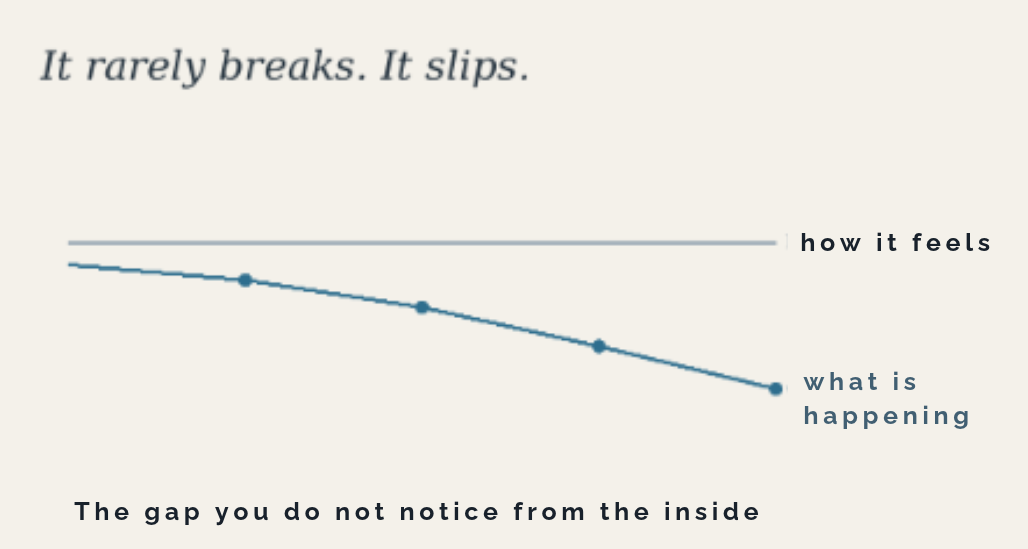
One of the more useful things I've learned about stakeholder trust is that you can start losing it long before you realise anything has changed.
When confidence breaks dramatically, at least you know. A significant failure, a risk that should have been raised, a commitment that wasn't met. Something happens that changes the relationship, and there is usually little ambiguity about it.
The harder situation is the quiet one.
Nothing obvious has gone wrong. The testing may still be strong, the reporting accurate and the programme moving reasonably well. Meetings continue, people remain professional, and nobody tells you they have stopped trusting your judgement. Yet something in the relationship has begun to shift.
I've been through that, and looking back, the signals were usually there. I simply found a reasonable explanation for each of them at the time.
That's what makes them difficult to read.
A meeting happens without you because everyone is busy. Someone checks a number because the programme is under greater scrutiny. A stakeholder asks more questions because the issue is important. You are brought into a discussion late because things moved quickly.
Every explanation may be perfectly true.
It is only when several of those things begin happening together, or when the pattern changes from what you were accustomed to, that they start to mean something more.
I think one of the earliest changes I've noticed is in how decisions reach you.
When stakeholders have confidence in your judgement, they tend to want it before they commit to matters where assurance is relevant. That doesn't mean testing gets a vote on every programme decision, nor should it. But there is usually an established rhythm in which people know when your perspective will be useful and involve you accordingly.
When that rhythm changes, you feel it before you can necessarily describe it.
You start hearing about decisions after they have been made. A direction has shifted, and you're being updated rather than consulted. Something that would once have prompted a quick call now appears in the minutes of a meeting you weren't in.
Any one of those things can be meaningless. Programmes move quickly, and not every decision requires assurance involvement. But when being informed begins to replace being asked, particularly in areas where your judgement was previously sought, I think it is worth paying attention.
The important word there is previously.
The signal isn't simply that a decision was made without you. It is that the relationship has changed.
I've seen something similar happen with assurance itself.
You give a position and later discover that somebody has quietly checked it elsewhere. Perhaps they have asked another person to validate a number, sought an independent view of a risk or gone back into the detail before being prepared to rely on the conclusion.
Again, none of that is inherently concerning.
Good governance involves challenge. Senior stakeholders should test important assurance, particularly when the consequences of getting something wrong are significant. I've worked in environments where independent challenge was expected regardless of how much trust existed between individuals.
What matters is the change in behaviour.
If your assurance previously provided enough confidence for the conversation to move forward and it now seems to require additional confirmation each time, something may have shifted. The organisation isn't necessarily saying that it doesn't believe you. It may simply be becoming less willing to rely on your judgement without corroboration.
That is a subtle difference, but an important one.
The same thing can appear in the questions you receive.
I don't think trusted leaders are questioned less simply because people believe them. Some of the strongest executive relationships I've had involved very difficult questions. In fact, trust can make those conversations more direct because neither side feels the need to protect the relationship from challenge.
What changes when confidence begins to slip is often the purpose behind the questioning.
Instead of questions designed to understand the position, you begin to encounter questions that seem designed to verify it. You find yourself repeatedly justifying assumptions that would previously have been understood. Details are revisited after you thought they had been settled. Answers that once allowed the conversation to move forward now lead to another layer of checking.
The difference can be difficult to identify while you're inside it.
I remember occasions when I interpreted increased questioning as greater executive engagement. Sometimes that was exactly what it was. On other occasions, looking back, I can see that the benefit of the doubt had narrowed and I hadn't recognised it yet.
That is why I am wary of treating any single behaviour as evidence that trust has been lost.
Stakeholder relationships aren't that mechanical.
People have different styles. Programmes move through periods of greater scrutiny. A new executive may ask far more questions than their predecessor. Regulatory attention can change the tone of governance almost overnight. Sometimes a stakeholder is simply having a difficult week.
Reading confidence requires more judgement than counting signals.
For me, the more revealing question has become: Is something different from the relationship we had before?
That change can also show up in timing.
One of the clearest signs that your influence may be weakening is finding yourself brought into conversations later than you used to be. You're still invited, still expected to contribute and perhaps still formally accountable for assurance, but the important thinking has already happened.
The options have narrowed before you arrive.
That connects closely with something I've written about elsewhere in The Quality Bar: influence tends to live upstream. Once decisions have hardened, assurance can still challenge them, but its ability to shape them is considerably reduced.
So when a testing leader who was previously involved early begins appearing later in the process, I wouldn't dismiss that too quickly.
Again, there may be a perfectly innocent explanation.
But if decisions are increasingly arriving after the fact, assurance is being checked elsewhere, questions have changed from understanding to verification and involvement is moving later, the individual explanations start to matter less than the pattern they form together.
That is usually the point where self-awareness becomes uncomfortable.
It is much easier to explain each signal away than to consider the possibility that people have become less confident in you.
I think experienced leaders can be particularly vulnerable to this because we have a history to draw upon. We know the quality of our work. We may have spent years building credibility with senior stakeholders and successfully navigating difficult programmes. When something in the relationship changes, our instinct can be to assume the environment has changed rather than consider whether our own standing has.
Sometimes the environment has changed.
But experience doesn't exempt any of us from losing trust.
I've come to think that the useful response isn't to diagnose the relationship too quickly. Marching into a stakeholder's office and asking why they no longer trust you can create a problem that may not have existed in the first place.
The better response, at least in my experience, is quieter.
I return to the behaviours that built confidence originally.
I make sure risks are surfacing early rather than waiting for somebody to ask about them. I look again at whether my reporting is as clear and balanced as I believe it is. If something is uncertain, I say so rather than allowing confidence to sound stronger than the evidence supports. If the programme is under pressure, I make a point of remaining visible rather than disappearing into the work.
Most importantly, I pay closer attention to whether what I say continues to hold up.
Trust is built through that consistency.
A stakeholder hears your position on Monday and finds that it still makes sense on Friday. A risk you raised early develops roughly as you described it. When you say something isn't serious, it turns out not to be. When you say something is serious, they learn that the word wasn't used casually.
Over time, those small experiences accumulate into confidence.
Which is why the reverse is also true.
Confidence can erode without any dramatic failure if enough small experiences begin pointing in the other direction. A position changes without a convincing explanation. A risk arrives later than it should have. A confident statement turns out to have rested on an assumption nobody mentioned. Nothing on its own destroys the relationship, but each event slightly changes how much weight the next assurance position receives.
That is why I no longer think rebuilding confidence is usually about a grand gesture.
If trust has been damaged by a major event, something more explicit may be required. But when confidence has simply begun to drift, the repair often looks remarkably similar to the way trust was built in the first place.
You become useful early again. Your assurance starts holding up consistently. Your answers become balanced enough that stakeholders don't feel they need to find the qualification themselves. You remain present when the programme becomes uncomfortable.
Gradually, the relationship changes back.
The decisions start coming to you earlier. The additional checking reduces. Questions return to exploring the issue rather than verifying your credibility. People begin asking what you think before the position has already formed.
There is rarely a moment when somebody announces that the trust has returned.
You notice it in the same quiet places where you first lost it.
That connection between everyday behaviour and stakeholder confidence is a large part of what led me to build the Stakeholder Management Masterclass for Test Leaders the way I did. Most of us learn these lessons slowly, through programmes where relationships work well and others where we eventually realise we misread what was happening. There is value in becoming more deliberate about them before experience forces the lesson.
Looking back, I think one of my mistakes earlier in my career was assuming that strong testing would carry my standing on its own. If the work was rigorous, the risks were understood, and the reporting was accurate, I assumed trust would largely look after itself.
I don't think that anymore.
The quality of the work remains the foundation, but stakeholders experience our leadership through all the small interactions surrounding it: when we speak, what we choose to surface, whether our judgement proves proportionate, and how we behave when the answer becomes uncomfortable.
Trust is built there, and it can begin to disappear there as well.
Perhaps that's why the early signs are so easy to miss. Nothing has broken yet. Nobody has withdrawn their support. There may be no conversation at all.
Just a few things that don't happen quite the way they used to.
I've learned not to panic when I notice them.
But I've also learned not to explain them away too quickly.